

The Science of Heart-Brain Coherence
Science-backed tools to reduce stress, build resilience, and optimize performance.
For 30+ years, starting with our first study published in the American Journal of Cardiology in 1995, HeartMath Institute has pioneered research in heart rate variability (HRV) and heart-brain coherence—revealing the heart’s role in relieving stress and improving emotion regulation, decision-making, and overall well-being.

Understand Your Psychophysiology
To better manage stress, from life’s daily challenges to major events.
Monitor and Master Heart Rate Variability
To maintain physical and emotional resilience.
Apply the Science to Achieve Coherence
So you can think, feel, and live in harmony.
OUR HYPOTHESIS
Harmonious communication between the heart and brain is the key to
well-being.
How do you achieve heart coherence—and what does it feel like?
HeartMath Institute has spent over three decades researching the heart-brain connection, contributing to a body of 215+ peer-reviewed studies — the large majority conducted by independent investigators — on how the heart and brain work together to support clearer thinking, steadier emotions, and better performance. Central to our work is heart-brain coherence (also known as HRV coherence or heart coherence)—a measurable state where your emotional, mental, and physical systems synchronize. This harmony shows up in your heart rate variability (HRV) patterns. When you achieve HRV coherence, your body creates optimal conditions for resilience, health, and performance.
- Heart-Brain Communication
- Heart Rate Variability
- Heart Rhythm Patterns and Emotions
Two-Way Communication
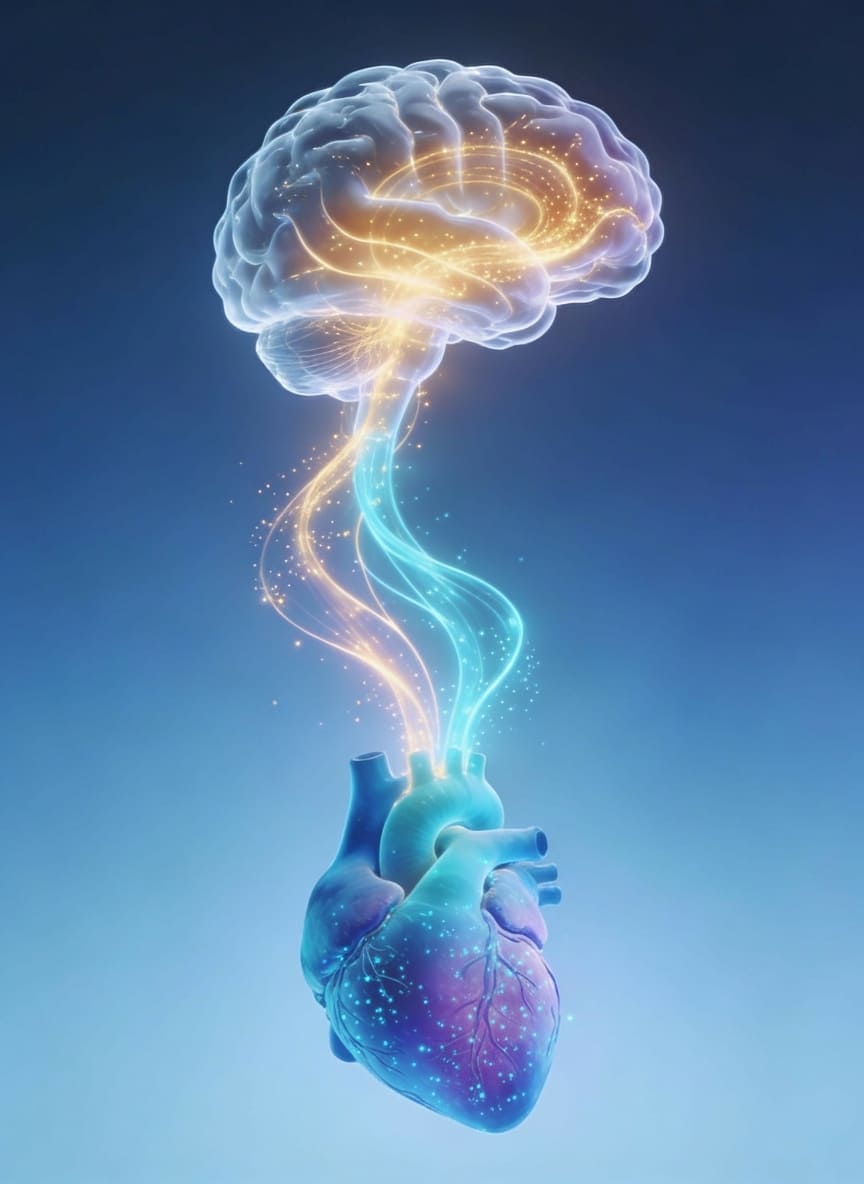
While most people are taught that the heart “takes orders” from the brain, research shows that the heart actually sends more messages to the brain than the brain sends to the heart! These messages have an important effect on brain function—influencing emotional experience as well as higher mental faculties such as clear perception, memory, and problem-solving.
This means that how we think, feel, and react is determined by both the brain and the heart. When these two systems work together in harmony, we experience what scientists call heart-brain coherence.
Dive deeper…
For the past 40 years, scientists have studied how heart activity affects brain function. While earlier research focused on effects over just a few heartbeats, HeartMath Institute researchers have discovered that larger patterns of heart activity have distinct effects on how we think and feel.
The Impact of Heart Rhythm Patterns
Research shows that different types of heart rhythms—which accompany different emotional states—directly affect mental functions, how we feel, emotional composure and the stability of heart-brain coherence. During stress and negative emotions, the heart’s rhythm becomes erratic and disordered. This chaotic pattern sends signals to the brain that inhibit higher mental functions, limiting our ability to think clearly, remember, learn, reason, and make effective decisions. This explains why we often act impulsively when stressed. These incoherent rhythms also reinforce the emotional experience of stress, creating a negative cycle and disrupting heart-brain coherence.
The Power of Coherent Heart Rhythms
In contrast, heartfelt emotional states create ordered, stable heart rhythm patterns. These coherent rhythms send messages to the brain that facilitate cognitive function and reinforce positive feelings and emotional stability. This means that learning to generate heart rhythm coherence (HRV Coherence) benefits the entire body and profoundly affects how we perceive, think, feel, and perform.
Heart Rate Variability
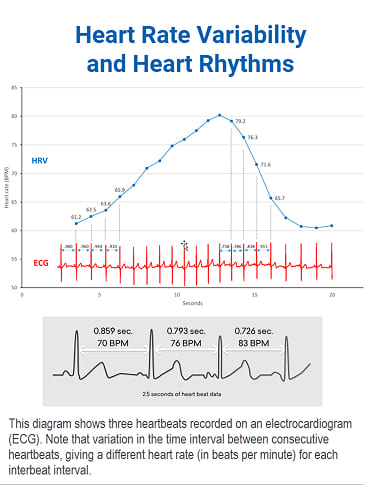
The heart at rest was once thought to operate like a metronome, beating out a regular, steady rhythm. Scientists now know this is far from the case. A healthy heart’s rhythm—even at rest—is always changing, with the time interval between each pair of heartbeats constantly changing. This naturally occurring beat-to-beat variation is called heart rate variability (HRV).
Understanding HRV
Heart rate variability measures the beat-to-beat changes in heart rate. This diagram shows three heartbeats recorded on an electrocardiogram (ECG). Note the variation in time interval between consecutive heartbeats, giving a different heart rate (in beats per minute) for each interval. Normal variability in heart rate results from the synergistic action of the two branches of the autonomic nervous system (ANS)—the part of the nervous system that regulates most of the body’s internal functions. The sympathetic nerves accelerate heart rate, while the parasympathetic (vagus) nerves slow it down. These branches continually interact to maintain cardiovascular activity in its optimal range and permit appropriate reactions to changing conditions. The analysis of HRV therefore serves as a dynamic window into the function and balance of the autonomic nervous system.
Why HRV Matters
Scientists and physicians consider HRV an important indicator of health and fitness. As a marker of physiological resilience and behavioral flexibility, it reflects our ability to adapt effectively to stress and environmental demands. Just as a tennis player’s shifting stance facilitates swift adaptation to receive a serve, a healthy heart remains similarly responsive and resilient, primed and ready to react when needed.
Observing Your Heart Rhythm Patterns
Moment-to-moment variations in heart rate are generally overlooked when average heart rate is measured (for example, when your doctor calculates that your heart is beating at 70 beats per minute). However, HeartMath’s HRV cohernece biofeedback technology allows you to observe your heart’s changing rhythms in real time, providing a picture of your HRV and the natural increases and decreases in your heart rate occurring on a continual basis. This visibility into your heart rhythm coherence patterns is essential for learning to self-regulate your physiological state.
Heart Rhythm Patterns and Emotions
Many factors influence HRV, including breathing patterns, physical exercise, and thoughts. Research at HeartMath Institute has shown that one of the most powerful factors affecting our heart’s changing rhythm is our emotions. When heart rate is plotted over time, the overall shape of the waveform is called the heart rhythm pattern. HeartMath research has found that the emotions we experience directly affect our heart rhythm pattern—revealing important information about how our body is functioning.
Incoherent Heart Rhythms
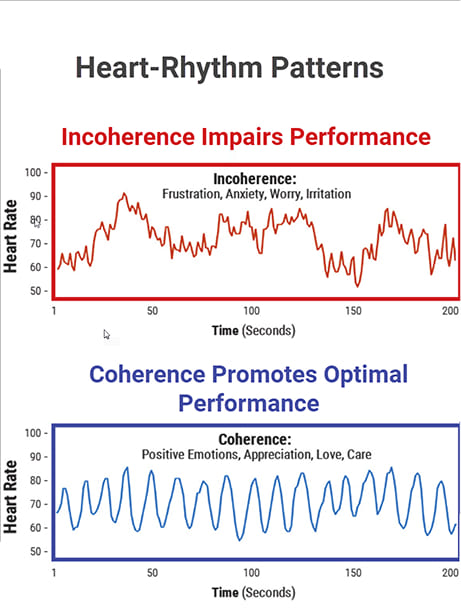
Emotional stress—including anger, frustration, and anxiety—creates heart rhythm patterns that appear irregular and erratic, with uneven, jagged peaks (shown in the figure to the side). Scientists call this an incoherent heart rhythm pattern. Physiologically, this pattern indicates that the signals from the two branches of the ANS are out of sync with each other.
This is like driving a car with one foot on the gas pedal (the sympathetic nervous system) and the other on the brake (the parasympathetic nervous system) at the same time—creating a jerky ride that burns more fuel and damages your car. Similarly, incoherent patterns associated with stressful emotions cause our body to operate inefficiently, deplete our energy, and produce extra wear and tear on our entire system. This is especially damaging when stress and negative emotions are prolonged or frequent.
Coherent Heart Rhythms
Positive emotions send a very different signal throughout our body. When we experience uplifting emotions such as appreciation, joy, care, and love, our heart rhythm pattern becomes highly ordered, appearing as a smooth, harmonious wave (shown in the graph to the right). This is called a coherent heart rhythm pattern or heart coherence. When we generate a coherent heart rhythm, the activity in both branches of the ANS synchronizes and the body’s systems operate with increased efficiency and harmony. Positive emotions feel good because they actually help our body’s systems synchronize and work better.
Comparing Heart Rhythm Patterns
The graphs to the right show real-time heart rate variability patterns (heart rhythm patterns) recorded from individuals experiencing different emotional states. The incoherent pattern (top) shows the irregular, jagged waveform typical of stress and negative emotions such as anger, frustration, and anxiety. The coherent pattern (bottom) shows the regular, sine-wave-like waveform observed when experiencing sustained positive emotions such as appreciation, compassion, or love. Note that the overall amount of heart rate variability is the same in both recordings—the difference lies in the pattern.
Featured Research

Personal Coherence
Heart Rate Variability (HRV) Biofeedback in a Global Study…
Comprehensive study, published in Nature, analyzing heart coherence across a global dataset. Shows how positive emotions correlate with optimal coherence frequencies (0.04-0.10 Hz) via HeartMath.

Social Coherence
Improving Your Heart Connections
Peer-reviewed study on how heart rhythm synchronization between groups increases prosocial behaviors (kindness, cooperation, trust) through biomagnetic fields. Definitive paper on social coherence.

Global Coherence
Global Consciousness Project 2.0: A First Look
This paper presents the Global Consciousness Project 2.0, using a worldwide network of random number generators to explore how collective human emotion and attention influence physical systems and global coherence.
Understanding Heart Rhythm Coherence (HRV Coherence)
What it is, how to measure it, and how to achieve it.
Heart Coherence: A State of Optimal Function
HeartMath Institute research has shown that generating sustained positive emotions creates a scientifically measurable state called psychophysiological coherence—characterized by increased order and harmony in our psychological and physiological processes.
This state of optimal function improves physiological efficiency, emotional stability, mental clarity, and cognitive function. Simply stated, our body and brain work better, we feel better, and we perform better.
Measuring Heart Rhythm Coherence
Physiologically, the coherence state is marked by a smooth, sine-wave-like pattern in the heart rate variability trace. This characteristic pattern is called heart rhythm coherence (or HRV coherence), and is the primary indicator of the psychophysiological coherence state. During coherence, several important physiological changes occur:
- There is an overall shift in autonomic balance toward increased parasympathetic activity.
- Multiple bodily systems synchronize to the rhythm generated by the heart (a process called physiological entrainment).
- Brain and heart activity become increasingly synchronized
Observing Entrainment in Real Time
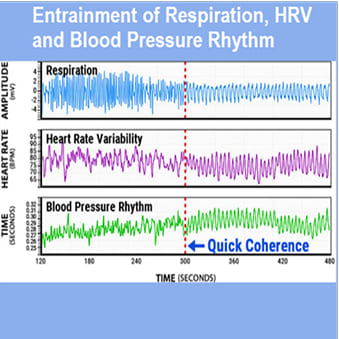
The figure to the right shows physiological entrainment during coherence. The graphs display an individual’s heart rate variability, blood pressure rhythm (pulse transit time), and respiration rhythm over a 10-minute period. At the 300-second mark (center dashed line), the individual used HeartMath’s Quick Coherence® Technique to activate appreciation and shift into coherence. At this point, the rhythms of all three systems came into entrainment—the patterns became harmonious and synchronized instead of scattered and out-of-sync.
Go Beyond Relaxation
Many people assume that coherence is simply another form of relaxation or stress relief. While coherence does help reduce stress, it is fundamentally different from traditional relaxation techniques in both its physiological mechanisms and practical applications. Understanding this distinction is essential for appreciating the unique benefits of heart rhythm coherence (also called HRV coherence) and how it can be applied in active, real-world situations—not just during quiet rest periods.
How Coherence Differs from Relaxation
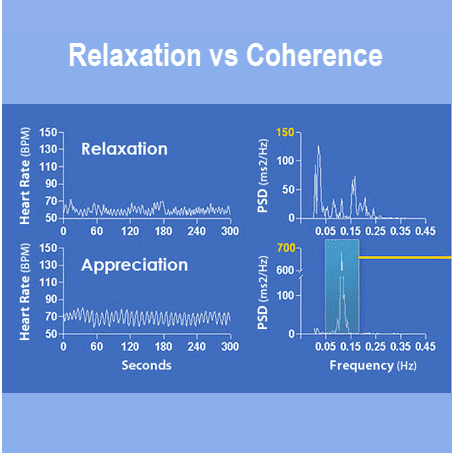
The state of coherence is both psychologically and physiologically distinct from relaxation. At the physiological level, relaxation is characterized by an overall reduction in autonomic outflow (resulting in lower HRV) and a shift toward increased parasympathetic activity. Coherence also involves increased parasympathetic activity, encompassing a key element of the relaxation response, but differs in that the system oscillates at its natural resonant frequency with increased harmony and synchronization in nervous system and heart-brain dynamics.
This important difference is reflected most clearly in their respective HRV power spectra (see figure left). Unlike relaxation, the coherence state does not necessarily involve a lowering of heart rate or a change in the amount of HRV, but rather is primarily marked by a change in the heart rhythm pattern.
Understanding the Pattern Differences
The figure shows typical heart rhythm patterns during relaxation and coherence. Relaxation produces a high-frequency, low-amplitude heart rhythm, indicating reduced autonomic outflow. The HRV power spectrum shows increased power in the high frequency band, reflecting increased parasympathetic activity (the “relaxation response”).
In contrast, the coherence state—activated by sustained renewing emotions, such as appreciation—produces a highly ordered, smooth, sine-wave-like heart rhythm pattern. Unlike relaxation, coherence does not necessarily reduce HRV and may even increase it relative to baseline. The coherence power spectrum shows an unusually large, narrow peak in the low frequency band, centered around 0.1 hertz. This characteristic spectral peak indicates the system-wide resonance and synchronization that occurs during coherence.
Psychological Differences
The psychological characteristics of these states are also quite different. Relaxation is a low-energy state where individuals rest both body and mind, typically disengaging from cognitive and emotional processes. In contrast, coherence involves the active engagement of positive emotions. Coherence is experienced as a calm, balanced, yet energized and responsive state that supports everyday functioning and interaction—including tasks requiring mental acuity, focus, problem-solving, decision-making, physical activity, and coordination.

The Role of Breathing
Understanding breathing’s role in coherence generation helps distinguish HeartMath techniques from traditional breathing exercises. While breathing slowly at a 10-second rhythm (5 seconds in, 5 seconds out) can generate a coherent heart rhythm and help shift out of stressful states, this cognitively-directed paced breathing can require considerable mental effort and is difficult for some people to maintain.
Beyond Breathing Exercises
While HeartMath techniques incorporate a breathing element, paced breathing is not their primary focus—they should not be thought of simply as breathing exercises. The main difference is HeartMath’s focus on the intentional generation of a heartfelt positive emotional state. This emotional shift is a key element of the techniques’ effectiveness.
Positive emotions appear to excite the system at its natural resonant frequency, enabling coherence to emerge and be maintained naturally without conscious mental focus on breathing rhythm. This is because the heart’s rhythmic activity is actually one of the main factors affecting our breathing rate and patterns. When the heart’s rhythm shifts into coherence through a positive emotional shift, our breathing rhythm automatically synchronizes with the heart, reinforcing and stabilizing system-wide coherence.
Broader Benefits of Emotional Focus
The positive emotional focus of HeartMath techniques confers a much wider array of benefits than those typically achieved through breathing alone, including:
- Deeper perceptual and emotional changes
- Increased access to intuition and creativity
- Cognitive and performance improvements
- Favorable changes in hormonal balance
Getting Started with HeartMath Techniques
To derive the full benefits of HeartMath tools, it is important to learn how to self-activate and eventually sustain a positive emotion. For users who initially have trouble achieving or maintaining coherence, practicing heart-focused breathing at a 10-second rhythm can be a useful training aid. Once individuals grow accustomed to generating coherence through rhythmic breathing and become familiar with how this state feels, they can begin practicing breathing a positive feeling or attitude through the heart area to enhance their experience and benefits. Eventually, with continuity of practice, most people become able to shift into coherence by directly activating a positive emotion.
More Ways to Engage
Support Our Next Initiative
As a donor, 100% of your support goes toward making the work we do possible – from funding scientific research to creating programs to developing global initiatives for interconnectivity.
Join Our Monthly Membership
Help us co-create a better world through your curiosity and generosity. A monthly gift of your choice helps advance the science of HeartMath and earns you access to invaluable members-only resources.
Fund a HeartMath Scholarship
Our scholarships give key groups like children, teachers, first responders, and veterans and their families access to our trainings so they can use coherence to create more connected communities.
Get Certified in HeartMath®
Ready to guide others to lasting change? Our certification programs teach coherence-based techniques that help people shift from stress to calm, improve relationships, and make clearer decisions.
Next Steps?

If you enjoyed this content, we’d like to recommend a great e-book that’s free and ‘peels the onion’ a few more layers.
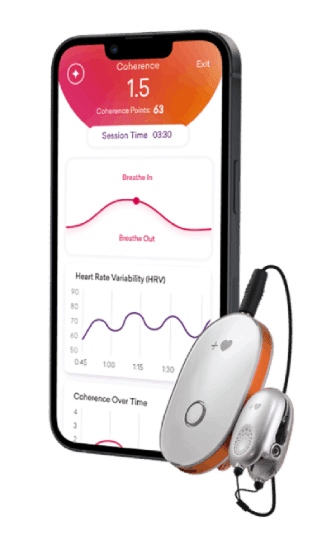
The Inner Balance™ Coherence Plus trains you to shift from emotional stress to heart rhythm coherence using techniques based on HeartMath Institute’s research.
FAQs
What is heart-brain coherence?
Heart-brain coherence (also called HRV coherence or heart coherence) is a measurable state in which a person’s emotional, mental, and physical systems synchronize. It shows up as a smooth, sine-wave-like pattern in heart rate variability (HRV) and reflects harmonious, two-way communication between the heart and brain. Achieving this state supports improved physiological efficiency, emotional stability, mental clarity, and cognitive function.
How is heart coherence different from relaxation?
Coherence and relaxation are physiologically distinct. Relaxation involves an overall reduction in autonomic nervous system activity and typically lowers HRV, marked by a high-frequency, low-amplitude heart rhythm. Coherence, by contrast, doesn’t necessarily reduce HRV — the heart’s system instead oscillates at its natural resonant frequency (around 0.1 Hz), producing an ordered, synchronized rhythm. Coherence also involves the active engagement of positive emotions, whereas relaxation is a lower-energy, more passive state.
What is heart rate variability (HRV) and why does it matter?
Heart rate variability measures the naturally occurring beat-to-beat changes in heart rate, driven by the interaction between the sympathetic and parasympathetic branches of the autonomic nervous system. Scientists and physicians consider HRV an important indicator of health and fitness, since it reflects physiological resilience and a person’s ability to adapt effectively to stress and changing conditions.
How do emotions affect heart rhythm patterns?
Emotions are one of the most powerful factors shaping heart rhythm patterns. Stressful emotions such as anger, frustration, and anxiety produce an irregular, erratic heart rhythm called an incoherent pattern, which sends signals to the brain that inhibit clear thinking, memory, and decision-making. Positive emotions such as appreciation, joy, and care produce a smooth, ordered coherent pattern that supports better cognitive function and emotional stability.
How much research supports HeartMath’s work on heart-brain coherence?
HeartMath Institute has spent over three decades researching the heart-brain connection, contributing to a body of 215+ peer-reviewed studies — the large majority conducted by independent investigators — on how optimizing this connection reduces stress, enhances emotional well-being, and improves clarity of thought and decision-making. This research began with HeartMath’s first study, published in the American Journal of Cardiology in 1995.
What role does breathing play in achieving coherence?
Breathing at a steady 10-second rhythm (5 seconds in, 5 seconds out) can help generate a coherent heart rhythm, but HeartMath’s techniques go beyond paced breathing alone. The key driver of coherence is the intentional generation of a heartfelt positive emotion, which excites the body’s natural resonant frequency and allows breathing to synchronize automatically with the heart — reinforcing coherence without requiring ongoing conscious focus on breath timing.