Education

"The emWave® is the perfect tool for helping to bridge the connection between emotions and learning. I have used it in my classrooms for 9 years. My students quickly learn to self-regulate their emotions and then apply that skill in the classroom and day-to-day life. They have more interest in learning, perform better on tests and get along better."

Dianna Govan

Dianna Govan, Carmel High School Chairman, Special Education Department

Institute of HeartMath Education

Emotion Self-Regulation Technology

The relationship between mind and emotions has been deliberated at length throughout history, with most schools of thought drawing a clear distinction between the two. Traditionally, such things as thinking, perception, arousal, attention, memory, reasoning, problem-solving and appraisal are seen as functions of our cognition, or the mental system, whereas feelings have been relegated exclusively to the domain of emotions. More recently scientists have begun to understand that such a dichotomy is not only imprecise, it obscures what is really a complex relationship between our cognitive and emotional systems. As Immordino-Yang and Damasio state, "processes of emotion have a profound effect on the very elements of cognition targeted in education. "

This deeper understanding of the interconnectedness of the cognitive and emotional systems has significant implications for such things as motivation to learn and perform, managing stress, making decisions, relating to others and improving overall health and well-being.

In recent years, the concept of "emotional intelligence," the ability to understand, manage and self-regulate one’s emotions, has emerged along with the idea that emotional maturity is as important as mental abilities in both personal and professional spheres. While many students can become aware of their emotions and understand them, learning to self-regulate their emotional state is much more challenging.

To facilitate the process of emotion self-regulation, HeartMath has developed a unique self-regulation technology called emWave®. The emWave is designed to work in conjunction with a series of tools and techniques, collectively known as the HeartMath System. This process enables people of all ages to self-regulate emotional experience and reliably generate a mode known as psychophysiological coherence. This state of optimal functioning is characterized by increased synchronization, harmony and efficiency in the interactions within and among the physiological, cognitive and emotional systems. You can discover how emWave is being used in education or learn about its theoretical basis.


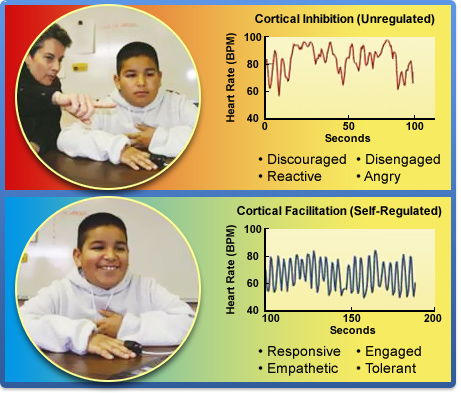
Heart-rhythm patterns during different emotional states.

Cortical Inhibition and Facilitation

The easy-to-use software program with heart rhythm monitor is based on the recent understanding that emotions are reflected in our heart rhythm patterns. Using the emWave, students quickly learn how to self-regulate emotions and bring balance to their mental and emotional systems. This balanced state facilitates both academic and social performance.

Learn More

The graphs above show examples of real-time heart-rate-variability patterns (heart rhythms) recorded from an individual experiencing different emotions. The incoherent heart-rhythm pattern shown in the top graph – characterized by an irregular, jagged waveform – is typical of an unregulated emotional state – stress and negative emotions such as anger, frustration and anxiety. The bottom graph shows an example of the coherent heart-rhythm pattern that is typically observed when an individual is experiencing a self-regulated emotional state.